The Q-PAC Fan Application Guide: Everything You Need to Know Before You Buy or Install
What is a Multimotor Plenum Fan (MPF)?
At its core, the multimotor plenum fan (MPF) is a new category of fan designed to solve the challenges that single-motor fans and fan arrays have long created in commercial HVAC. Traditional single-motor fans offer simplicity but no redundancy. When the motor fails, airflow is lost. Fan arrays introduced resiliency, but at the cost of added complexity in design, installation, and operation.
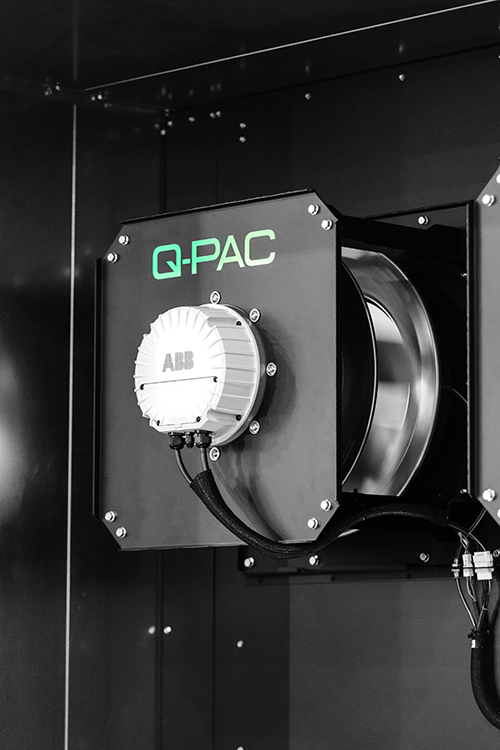
The Q-PAC Multimotor Plenum Fan bridges this gap. It provides the simplicity of a single device with the added resiliency of multiple motors. With pre-wired motors, a Fan Controller for a single point of connection, and an adaptive fan frame, the MPF removes the tradeoffs that engineers, contractors, and facilities managers have had to accept in the past.
Why We Built the Application Guide
When we pioneered the MPF, we ushered in a new way of thinking about commercial fan systems. But, with new technology comes new questions:
Will an MPF meet the dimensional and performance requirements of my existing or new AHU?
What installation requirements should I know before specifying?
Which control option do I need?
The Q-PAC Fan Application Guide was created to answer all these questions and more in one place. It’s more than a manual, it’s a comprehensive resource that explains how the MPF works, where and how it should be applied, and how to get the most value out of your applications.
What's in the Guide
The Application Guide provides a full overview of the MPF, including:
Technology Overview
The guide explains what the MPF is and how it compares to single motor fans and fan arrays, using side-by-side tables highlighting differences in simplicity, resiliency, and performance. This helps cut through the noise and gives a clear picture of why the MPF is different.
Applications
The guide outlines where the MPF should be applied, specifically commercial applications like healthcare facilities, schools, entertainment venues, and transportation hubs. It also covers where the MPF should not be applied, like harsh industrial facilities and high-temperature environments. Knowing this upfront avoids wasted time evaluating systems that aren’t a fit.
Replacement Scenarios
The guide provides retrofit details that show which legacy fans the MPF can replace, from centrifugal blowers to arrays, along with the considerations that come with each. This makes it easier to map out upgrade projects, anticipate potential adjustments, and eliminate the learning curve.
Specifying Guidance
Practical direction is included on how to measure properly, account for clearances, and confirm allowable configurations. These details ensure that specifications are correct the first time, helping prevent costly mistakes later in the process.
Installation Guidance
High-level instructions are available for both assembled and knockdown variants, covering frame assembly, perimeter angles, and multi-fan systems. Having this clarity upfront simplifies planning and reduces on-site surprises during installation.
Components and Architecture
The guide gives a high-level overview of the fan frame, Fan Controller, plug fans, and frame harnessing, showing how each part fits together. Understanding the product architecture makes it easier to see how the system works as a whole and how each component contributes to performance.
Power and Controls
A section is dedicated to explaining how the Fan Controller serves as the brain of the MPF, managing power and communication through analog, Modbus, or BACnet connections. It also covers other accessories like disconnects and control panels, so you know exactly how the fan integrates with various controls options.
Maintenance and Reliability
Finally, the guide shows how plug fans can be replaced in minutes and why modularity makes long-term ownership simpler and more cost-effective. This transparency ensures you know what to expect, not just at installation but throughout the fan's life.
Why the Guide is Helpful
The application guide is not just another spec sheet, it’s a decision-making tool. It brings together configuration details, performance data, installation methods, and MPF architecture in one place, making it easier to plan projects efficiently and avoid in-field surprises. With everything clearly explained, from specifying requirements to installation options, this guide provides the clarity to make confident decisions about the Q-PAC MPF. Consolidating this information ensures HVAC professionals can fully evaluate the MPF before and after installation.