Programeering in Practice: Bridging the Gap Between Engineering and Software in Modern HVAC Fan Design
In traditional product-led companies there is a clear split between software developers and physical product designers. The software teams could be made up of Computer Engineers, Software Engineers, UI/UX Designers, and Software Architects. The product design team would be made up of Mechanical Engineers, Electrical Engineers, and Product Designers. For most companies focused on product development this works well.
For an HVAC manufacturing company, it is not typically required that the software team knows the deep in and outs of the product design and performance. They wouldn't need to know the component dimensions, the routing of wires in the product, the location of screws, or how to calculate performance of electric machines.
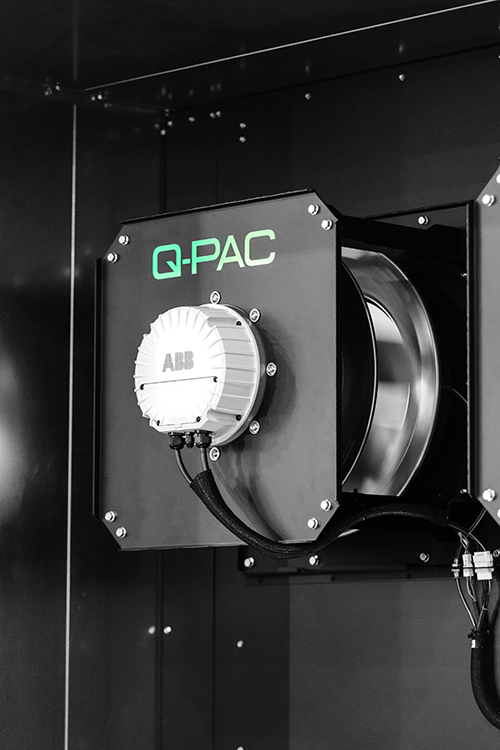
This approach presents a unique opportunity for enhanced collaboration in the manufacturing and design world. What if every dimension, every screw hole, and every wire route was different each time a customer wanted the product? What if the ideal experience is for the customer to see the product design adjust real-time on screen as they make changes to the physical components? What if the product was equal parts hardware and software? This is where Q-PAC lives. The Q-PAC Fan is a dynamic product that was created alongside software tools that allow for instant configuration based on the information entered by the consumer.
To do this effectively, the product’s design engineers were heavily involved with writing the logic for the software that drives the real-time configurations. Thus, the concept of the Programeer was born.
Our engineering team plays a critical role in software development because every dimension entered into the tool must instantly translate into a design that can actually be manufactured. The product can be built in 22 different plug-fan layouts, each with its own size limits and performance capabilities, so when a user enters a height and width, the software has to determine which layouts and fan models will fit and still meet the required airflow. Each plug fan also needs a dedicated harness route back to the Fan Controller—which can be located on either side of the unit—so wire paths and lengths must dynamically update with every configuration change. To maintain proper airflow, the spacing between plug fans must be kept as equal as possible across the available mounting area, requiring continuous recalculation of panel widths and layout spacing. If backdraft dampers are included, the structural channels must be positioned far enough apart to accommodate the damper frames, which affects the minimum allowable dimensions. Even the placement of mounting holes and harness tie-points must adjust automatically to avoid panel seams and align with panel widths. All of this real-time logic is driven by engineering expertise, ensuring that what appears on screen is not only accurate, but truly ready to build.
Figure 1: Represents a 2-2-2-2 layout. There is a minimum and maximum size associated with each. When the customer enters a height and width they need, the logic has to determine which layouts and which plug fan models fit and meet the performance.
Figure 2: Each plug fan in each layout has a dedicated harness path back to the Fan Controller. Depending on the size and layout, the wire lengths and paths have to be drawn and updated.
These examples of the sizing logic and its complexity is only one piece of the puzzle. There is an equivalently complex set of logic for the performance calculations, the BOM creation, the packaging logic, and the document creation. In order to deliver a fully built-to-order product quickly and efficiently, the design and processing logic must be automated.
Even with the introduction of the Programeering function, there is consistent strategic collaboration with the software team. While the design engineers are trained in system functions for updating logic and ensuring consistency between specs and product output, the software team brings this to life in a scalable way. Building pipelines, developing automations, enhancing coding environments and teaching proper coding practices are just a few of the many ways the software team partners with the design engineers to ensure processes are implemented accurately and efficiently. This way of working would not be possible without the skillset of both teams and their commitment to ongoing partnership.
Programeering is a key function of every engineering role at Q-PAC, and will continue to be a unique element of the organization as the product grows and develops. It fosters seamless integration between the physical product and the technology used to develop it, and broadens the skill set of the design engineers who are working with the product day-to-day. As we explore the next chapter of fan technology, there is little room for separation between software and hardware; the two areas will continue to converge, and the Engineering & Software teams will continue ongoing collaboration to develop the best product for our customers, for the continued improvement of airflow.