You Have More Control Than You Think: Choosing the Right Fan for Your Air Handler
In most mechanical rooms and air handler submittals, the same pattern shows up: HVAC fan selection is treated as a fixed decision. The fan is selected, approved, and rarely reconsidered. For many engineers and end users, the assumption is straightforward: the air handler comes with a fan, and that fan is what it is.
In practice, most people aren’t really shopping around or comparing HVAC fan options. The fan that gets picked is usually the one that feels safest or most familiar, often the same as the original, something already specified, or a technology they’ve used before.
Sometimes it comes down to speed. When deadlines are tight or a replacement is urgent, the quickest path forward wins. There is also an assumption that fan options are limited by the air handler manufacturer or integration partner. These factors tend to reinforce the same outcome: the known option wins.
This approach can limit system performance, energy efficiency, and long-term reliability.
In actuality, the fan inside an air handler is not a fixed choice; it is a design decision, and like any decision, it has consequences.
The Hidden Impact of the Fan on the HVAC System
Fans are not just air movers. They are the engine of the system. HVAC fan selection directly influences:
Energy consumption
Sound levels
Uptime and system reliability
Maintenance demands
Installation and integration
A change in fan selection can affect the entire lifecycle of the system, yet it is one of the least examined aspects of air handler design.
For facility managers, these decisions show up in day-to-day operations. How often does the team need to respond to issues? How much time goes to routine maintenance versus higher priority work? What happens when a failure occurs, and how disruptive is it? The fan plays a role in each of these outcomes.
So why is it often treated as a default?
In many cases, it comes down to familiarity and pressure. Engineers are working against deadlines. Contractors want to avoid installation issues. Facility teams inherit systems and rely on what they know. Under those conditions, the standard option often feels like the safest choice, even when it may not be the best one.
Defaulting to Traditional Blowers and Plenum Fans
Historically, most air handlers have relied on a single large fan, typically belt-driven or direct drive. This approach is well understood, widely available, and proven to work. It also comes with tradeoffs.
A single fan creates a single point of failure. Turndown efficiency is limited. Belt-driven systems introduce ongoing maintenance. In some cases, achieving the required airflow also means a larger footprint.
For a long time, this was the only practical option available, so it became the standard.
Alternatives like fan arrays are a relatively recent development, but as is often the case, standards tend to persist even after new options become viable.
The Rise of Alternative Fan Systems
Advancements in motor technology and system design have introduced new ways to move air. At the same time, tighter energy and operational standards have raised expectations around efficiency and system performance. Designing around a fully redundant fan system is not always as acceptable as it once was.
Engineers and end users now have more options to consider, including:
Fan Arrays
Fan arrays are an alternative HVAC fan system that uses multiple smaller fans working together to deliver the required airflow. Instead of relying on a single motor, the load is shared across several fans. This creates built-in redundancy. If one fan fails, the system can continue operating, often with minimal impact, rather than shutting down entirely.
They can also improve part-load efficiency by allowing the system to adjust capacity more precisely.
At the same time, this approach introduces added complexity. Coordinating multiple fans requires more advanced controls and additional wiring. Installation and commissioning can be more involved, especially with custom or one-off system designs. Ongoing maintenance can also be more demanding, with more components to access, monitor, and service over time.
Multimotor Plenum Fans (MPFs)
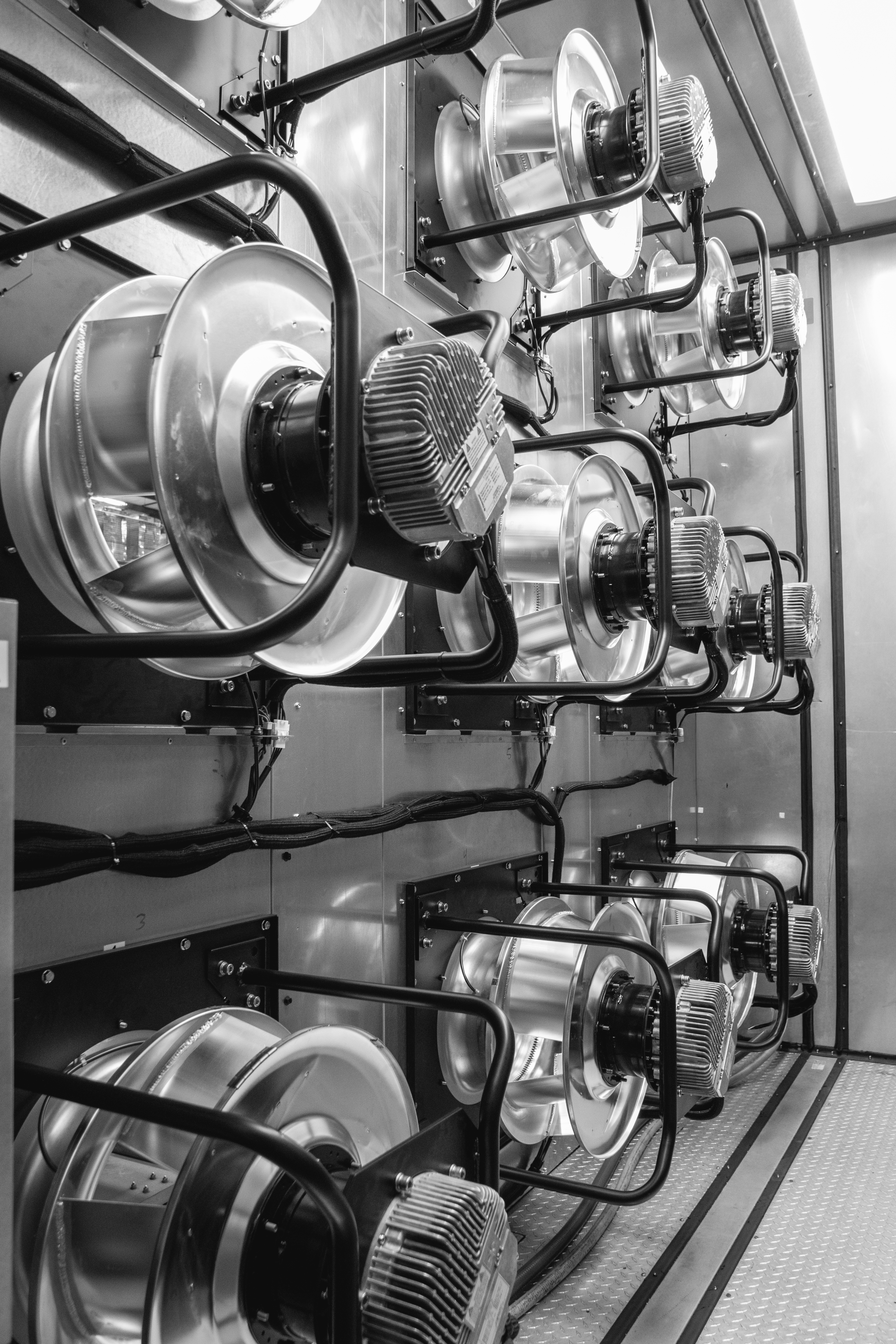
Multimotor plenum fans (MPFs) are a newer HVAC fan technology that build on the concept of fan arrays by using multiple motors to share airflow within a single assembly.
A multimotor plenum fan integrates several electronically commutated (EC) motors, each directly mounted to a backward-curved impeller. In that sense, it mirrors the multi-fan architecture of fan arrays, distributing airflow across multiple operating points rather than relying on a single motor.
The distinction is in how the system is packaged and controlled. Instead of separate fans coordinated through field-installed controls, the motors and control architecture are integrated into a single, pre-engineered assembly. This presents as one connection point for power and controls, reducing the need for custom coordination in the field. From a performance standpoint, the shared load across multiple motors provides a level of built-in redundancy similar to fan arrays.
Why Fan Selection Matters More in Modern HVAC Systems
HVAC fan selection plays a significant role in overall system performance and energy consumption. Fans operate for thousands of hours each year and can account for up to 40% of an HVAC system’s energy use. Small differences in efficiency, maintenance requirements, or reliability add up quickly over time. What feels like a minor decision during selection can become a meaningful operational factor once the system is running day after day. That decision can influence whether downtime is planned and controlled or unexpected and disruptive.
At the same time, expectations around system performance are changing. Owners are asking for greater visibility into energy use. Contractors are under pressure to streamline installation. Engineers are expected to deliver systems that balance efficiency with reliability.
The fan sits at the center of these demands. In many systems, the fan is one of the largest contributors to total HVAC energy use and maintenance requirements.
Choosing the familiar option may still work. But it is no longer the only consideration, and it may not align with how systems are expected to perform today.
Key HVAC Fan Selection Questions for Engineers and Facility Owners
Rather than treating the fan as a fixed component, it is worth stepping back and reframing the discussion. When evaluating HVAC fan selection, questions like these can help guide the decision:
What happens if the fan fails?
How does the system perform at part load?
How much field labor is required for installation and commissioning?
What does long-term maintenance look like?
Are there alternatives that better align with the project’s priorities?
These are not theoretical considerations. They directly impact cost, performance, and day-to-day reliability.
Rethinking Default Fan Selection in HVAC Systems
Most projects do not fall short because of a lack of available technology. More often, they reflect decisions that were never revisited. Fan selection is frequently one of those decisions.
The HVAC industry still relies on legacy design decisions that persist because they are familiar, not because they are optimal. Fan selection is a clear example.
Today, engineers and facility owners have more control than they realize. Evaluating available fan technologies does not add unnecessary complexity. It provides a clearer understanding of how different approaches affect performance, maintenance, and system behavior over time.
When fan selection is approached as an intentional design decision, rather than accepting a default or assumed standard, the result is more likely to align with modern system requirements.
Airflow should be considered intentionally. Whether the solution is a traditional single fan, a fan array, a multimotor plenum fan, or other technology, each approach represents a different balance of efficiency, redundancy, and complexity.
For air handler updates or replacements, reviewing current fan options can reveal differences that are not always visible at the specification stage. These differences often show up later in operation, maintenance, and overall system reliability.
If you are planning an air handler project or evaluating HVAC fan options, the Q-PAC team can help determine whether a Q-PAC fan is a fit for your application.