Commercial air handlers already live in a tough world: heat, humidity, dirty coils, and 2 a.m. service calls. In seismic regions, they also have to deal with earthquakes. If the fan system in a critical building can’t survive and keep running after a major event, everything else downstream is at risk.
That is why we took the Q-PAC Multimotor Plenum Fan (MPF) to a three-dimensional shake table in Reno and pushed it through ICC-ES AC156 seismic testing. The result is HCAI Special Seismic Certification Preapproval OSP-0875 for the Q-PAC Fan. See the OSP here: https://hcai.ca.gov/document/OSP-0875/
This article walks through what that certification means, why we did it, how we tested, and what it changes for engineers, contractors, resellers, and facility managers.
Seismic Certification Verifies Fan System Performance and Continuous Operation
Seismic certification is third party proof that equipment can:
- withstand earthquake shaking,
- stay anchored, and
- for critical systems, keep operating afterward when it is installed the way it was tested.
For mechanical equipment, this is usually done through full scale, three-axis shake table testing to International Code Council Evaluation Service (ICC-ES) AC156. AC156 is the standard many building codes and agencies, including HCAI/OSHPD in California, rely on to qualify nonstructural components like fans, air handlers, switchgear, and control panels.
The Q-PAC Fan was tested on this type of table and then reviewed and approved under HCAI’s Special Seismic Certification Preapproval (OSP) program.
Seismic Certification Requires Testing, Verification, and Regulatory Pre-Approval
The Q-PAC Multimotor Plenum Fan is now listed under: HCAI Special Seismic Certification Preapproval OSP-0875.
A few important details:
- What was tested:
The certification covers the Q-PAC MPF in its entirety, including the full catalog of motorized impellers, configurations, and sizes up to the full 150" width and 140" height. It also covers fan system accessories, such as Q-PAC Control Panels and backdraft dampers. - Where it was tested:
Testing was performed at the University of Nevada, Reno on a three-dimensional shake table, and the results were certified by Pre Compliance, an independent structural engineering firm. - What standards does this support:
The preapproval supports projects designed to International Building Code (IBC) 2024 and California Building Code (CBC) 2025, and it is classified at Ip = 1.5, the higher importance factor used for essential facilities (hospitals, critical infrastructure, etc.). - How the OSP program works:
The OSP program is a voluntary preapproval path for manufacturers. HCAI requires full scale shake table testing to AC156, plus an independent California structural engineer’s review. For active mechanical and electrical equipment like fans, HCAI does not accept calculations alone. They want test data.
In short: the Q-PAC Fan is not just “qualified by test.” The MPF has a full HCAI Special Seismic Certification Pre-approval with its own OSP number.
What Seismic Level is the Q-PAC MPF Certified For?
The OSP-0875 certificate defines the seismic demand in terms of SDS (short-period Design Spectral Response Acceleration) and height in the building.
SDS is the value engineers already use on their drawings when they talk about seismic demand. If a project calls for SDS = 1.5 at the roof, the Q-PAC MPF fits within the OSP. If it calls for SDS = 1.7 at the roof, we are outside the certified range and the project needs a different approach.
For the Q-PAC MPF, the preapproval covers:
- SDS up to 2.50 g at grade (ground level)
- SDS up to 1.61 g at roof or elevated locations, including height effects
- Importance factor Ip = 1.5
In practical terms:
- SDS ≤ 1.61 at the roof covers almost all of the United States and most of California.
- Only relatively small pockets located directly along major faults exceed that and need project-specific engineering.
Because the MPF is certified at Ip = 1.5, it is intended for essential facilities, where the expectation is not just “don’t fall over,” but “stay in place and keep operating after the design-level earthquake.”
Seismic Certification Drives Impact for Facility Managers, Engineers, and Building Owners
Why Seismic Certification Matters to Facility Managers, Engineers, and Building Owners:
- Hospitals have a 2030 deadline.
In California, general acute care hospitals that plan to stay open after January 1, 2030 must meet both structural and nonstructural seismic requirements. That includes air-handling systems and the components inside them. If fans are not seismic, owners are going to have a hard time justifying their HVAC choices. - Engineers wanted a clean path for Q-PAC in seismic projects.
Q-PAC Fans have been installed in hospitals and high-reliability facilities for years, but the conversation often turned into, “We love the concept, but how do we get this past HCAI?” A full OSP allows engineers to point to a recognized program and say, “This fan is already specially seismically certified.” - Reinforcing trust and confidence in the Q-PAC Fan.
Seismic testing is not cheap or easy. Taking an entire fan system to a university lab, building test fixtures, and running repeated shake table events is a commitment. This level of effort signals that Q-PAC is not a niche retrofit gadget. It is a legitimate commercial fan option for code-driven, high-stakes projects.
From Test Planning to Certification: How the Q-PAC MPF Seismic Performance Was Verified
From the outside, an OSP is just a number on a certificate. Getting that number, though, is an involved process.
Here is the short version of what happened in Reno:
- Building the Test Unit
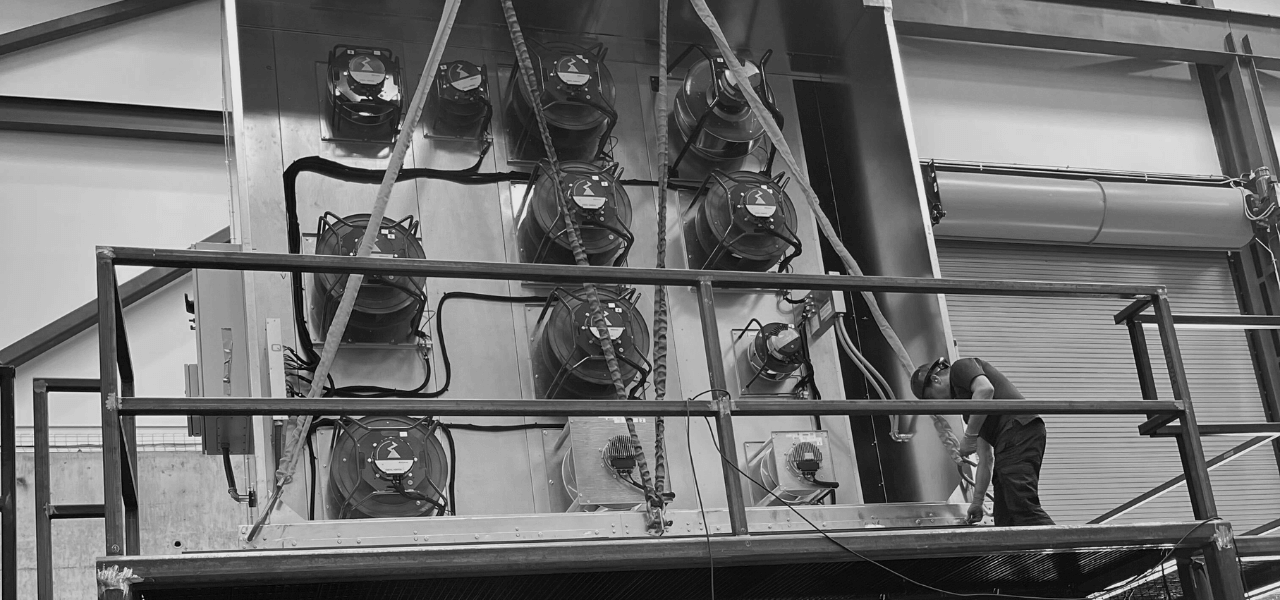
We assembled a Q-PAC MPF of the largest size offered, with variations of the smallest and largest plug fans offered in the catalog. This included the frame, multiple plug fans, two Fan Controllers, frame harnesses, and two Q-PAC control panels - all installed inside a mock air handler. We shipped the assembled air handler out to Reno on a flatbed, having to avoid quite a few overpasses due to its height. - Mounting to the Shake Table
Once in Reno, the entire assembly was bolted to a steel test fixture that simulated the mock air handler mounting structure and allowed our structural engineer to control how the loads were transferred. The anchorage details and sheet metal thicknesses were carefully chosen because those become part of the preapproval. - Running AC156 Motions
The table then ran through a series of AC156 motion sets for calibration purposes. Each motion is a three-dimensional time history tuned to the target SDS, frequency content, and damping. The idea is to subject the fan system to a realistic earthquake shaking in all three directions at once. - Increasing the Demand
We did not walk in at the final SDS level and hope for the best. The testing program stepped through multiple runs at increasing demand levels, checked for damage or loosened fasteners, and verified that the fans could still operate. The first round of testing revealed some shipping-related damage, and that first shake had to be re-done after evaluating the perimeter angle screw spacing and sizing the next day. - Verifying Performance
After the strongest runs, we inspected the assembly for permanent damage and then operated the fans to confirm they still ran as intended.
The final findings: the Q-PAC Fan completed the required AC156 tests at the certified SDS levels, stayed anchored, and remained operable. The passing of these tests is what underpins OSP-0875.
Receiving seismic certification creates additional opportunity to install Q-PAC Fans
In practical terms, seismic certification gives the Q-PAC Fan a clear, code-aligned path into projects where its use was previously uncertain, especially in California hospitals and other high-seismic regions.
New Construction
The most apparent new opportunity lies with air handlers that already have a seismic OSP and list a fan array.
When an air handler has its own OSP and includes a fan array, a Q-PAC fan can often be treated as an equivalent replacement if the mounting is similar (Daikin Vision Skyline OSP-0325, HuntAir AHU OSP-0416, etc).
In those cases, our structural partner is very confident HCAI will treat the Q-PAC MPF as a like-for-like seismically certified component. This opens the door for OEMs and their reps to offer a 100% resilient, ECM fan solution with a recognized seismic path, instead of being locked into one legacy fan system.
Retrofits
Retrofits are more nuanced, but the OSP still helps.
- In seismically certified air handlers (roughly 2009 and newer) that already have a fan array, replacing that array with a Q-PAC Fan of similar or lower weight and similar support is a very feasible option. It will still go through design review, but now there is test data and a preapproval to support it.
- In seismically certified air handlers (roughly 2009 and newer) originally certified with a blower instead of a fan array, a Q-PAC Fan can still be used, but it will require site-specific seismic approval to show that replacing the blower with a four-side-supported Q-PAC Fan is acceptable. In this case, OSP-0875 and our structural engineer’s letter become key elements of the justification.
- In older, non-certified air handlers, any fan solution (including a Q-PAC Fan) needs site-specific seismic approval. For this scenario, OSP-0875 becomes strong evidence, but requires more research and testing before giving a final decision.
The key point for engineers and owners: the Q-PAC Fan is now in the same seismic conversation as the major OEM solutions, with data to back it up.
Seismic Certification Improves Fan System Effectiveness for Building Owners
For facility managers, system integrators, and OEMs the value of this certification comes down to a few key advantages:
- One of the only retrofit options with a standalone fan OSP
Most seismic fans are locked inside a specific OEM air handler listing. The Q-PAC MPF is one of the only retrofit-friendly fan systems with its own HCAI Special Seismic Certification Preapproval (standalone fan OSP), so it can be engineered into a wide range of AHUs instead of just one manufacturer’s box. - Knockdown kit that actually reaches the mechanical room
The Q-PAC Fan ships as a true knockdown kit: panels, frame, and fans that break down, go through doors and elevators, and assemble inside the existing mechanical room. Seismic certification on top of that design makes the Q-PAC fan a rare fan system that is both retrofit-focused and seismically preapproved. - ECM performance, now with seismic
The Q-PAC fan provides high-efficiency ECM plug fans, precise control, and multi-fan redundancy, in a configuration that is now seismically certified. You do not have to fall back to legacy AC blowers just to satisfy seismic requirements. - Low maintenance, premium controls, fits almost any AHU
Direct-drive EC fans mean no belts, sheaves, or external bearings to maintain. The Q-PAC fan can be paired with our premium control solutions when needed, and the modular MPF geometry allows the fan to fit into almost any air handler footprint while still matching the certified mounting approach.
Working on a Project With Seismic Requirements?
Earning OSP-0875 is not the end of the story for the Q-PAC Fan and seismic. It is the current product baseline.
The Q-PAC Fan will continue working with structural engineers, OEM partners, and system integrators to:
- Expand the number of configurations and air handler platforms where the MPF can be used under this preapproval,
- Support site-specific engineering for complex retrofits, and
- Share what we have learned about practical seismic design of fan systems.
If you are working on a project that has seismic requirements, a 2030 hospital deadline, or just a lot of “what if” questions, our team is happy to chat further.