Why a Multimotor Plenum Fan is Not a Fan Array
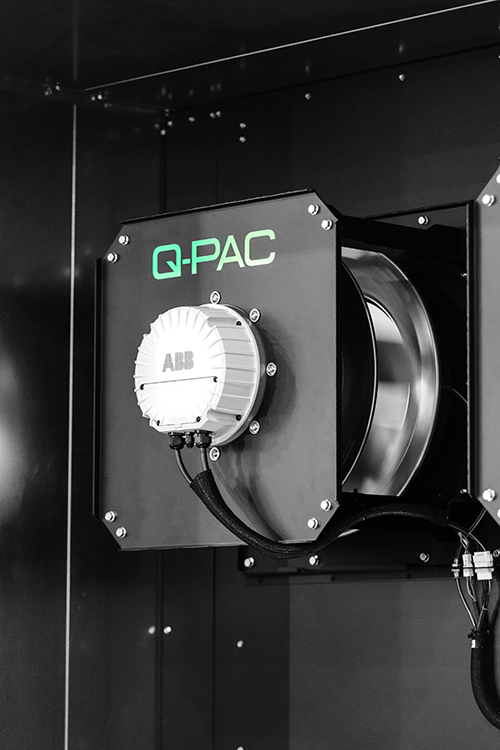
A multimotor plenum fan (MPF) is a fan that combines multiple motorized impellers, a single connection point for power and controls, a frame, and a single performance profile. The result is a single device that has multimotor air movement.
When we think about a single device, we think of a cohesive, complete, and ready-to-run device. When you buy a new car, you don't have to supply your own tires. When you buy a laptop, you don't have to terminate any internal wires. When you buy an IKEA desk, you don't have to buy your own screws. A complete device is the full package. Q-PAC views the MPF the same way - a complete fan that can be dropped in place or simply assembled on-site.
In contrast, a fan array is not a single device, but many separate devices, components, and services that require coordination for functionality and installation. Fan arrays may arrive at a jobsite on pallets with all the components needed to get it up and running, but they require connecting all fans to an external control panel, sheet metal fabrication to close airstream gaps, external circuit protection, and multiple penetrations through an air handler.
Fan arrays were introduced into the market for two main reasons: the first is because the fans that could meet the building's requirements were too large to efficiently install and maintain, especially as buildings started getting bigger and the performance expectation kept growing. The second reason is that the cost of reliable airflow was too high. Having large, redundant blowers or even air handlers was neither cost-effective nor space-saving for most buildings. At the time, it was assumed that facility teams or service teams would handle the complexity of installing, operating, and maintaining the arrays. These arrays were the niche, premium product that provided buildings with reliable airflow and a small air handler footprint.
In today's HVAC space, most equipment comes loaded with an abundance of features, IoT connections, a multitude of sensors, or an overload of data that is largely irrelevant or distracting to a facility manager. The MPF was designed to simplify the complexity of reliable airflow and excel at being a fan, just like the blowers and single motor fan solutions.
A Closer Look at Differences
An MPF and a fan array may look similar, but their functional and intangible differences are distinct.
Productization
- MPF: Fully engineered product with defined specifications and certifications. An MPF covers the entire scope of a fan. Having predicted mounting locations for all components and harnesses, single-point power and control, a frame that acts as a pressure wall and a mounting surface for the motors, the ability to be handled as a single assembly, and productization for single-source support and replacement parts.
- Fan Array: Collection of independent fans installed on-site that may require on-site sheet metal fabrication, custom harnessing, and/or on-site motor wiring.
Electrical Integration
- MPF: Standardized electrical connection location on the fan. Predicted and standard connections from each motor to a single point of power distribution. Connection interface as a single device.
- Fan Array: Requires integration of external drive or drives, custom wiring back from each motor to a control panel, or external electrical protection. Connection interface varies widely.
AHU Integration
- MPF: Single penetration for power and controls.
- Fan Array: Multiple penetrations required for each fan's power and controls signal.
Performance
- MPF: Operated and tested as a single device, one fan curve. On a schedule, there would be QTY 1 of the MPF with the full performance capabilities.
- Fan Array: Performance = Individual fan performance x Quantity. On a schedule, there would be QTY 6 of the fans with the performance representing one fan's capability with the expectation that the performance will be multiplied.
When Would a Fan Array Be Preferred?
There are times when a fan array would be preferred over an MPF. One of the strengths of fan arrays is their flexibility for one-off designs or custom control and communication.
High Airflow Requirements
Buildings that require large amounts of airflow may need multiple fans to meet the required performance. No single fan on the market may meet the airflow and pressure needs without having multiple in the airstream.
Highly Custom Airstreams
Some installation locations require that custom frames or mounting structures be made. When there are obstructions or imperfections that force the individual fans to be isolated or removed from the same frame assembly, a fan array can be best due to its custom and one-off nature. A standardized product would not be best for a nonstandard application location.
Advanced Monitoring or Control
In some applications, controlling multiple fans as standalone devices can be required. The MPF offers simplicity and reliability for most commercial applications, but a fan array can be custom-engineered for applications requiring advanced individual motor monitoring, shutoff, and isolation of different fans, or unique control schemes that need to bypass centralized communication.
Where to Learn More about a Multimotor Plenum Fan
Q-PAC is spearheading the implementation of the MPF into the HVAC market and making it available to end-users, Manufacturer’s Reps, Specifying Engineers, and building owners. The Q-PAC MPF comes with additional features that make it distinct from other MPFs that are available. Some of the additional features that come standard with a Q-PAC MPF are: an adaptive frame that expands to the airstream dimensions which eliminates the need for custom sheet metal fabrication; assembled or knockdown options for flexibility depending on installation location; communication of real-time airflow output; quick motor replacement; predetermined harness routes for predicted and standard harnesses; and ETL certification as a full assembly.