Exploring Types of Commercial HVAC Fans
What is a fan?
Before diving into different fan types, we need to define what a fan actually is. Broadly speaking, a fan is any rotating device that creates an air current by imparting velocity and a pressure increase. Pumps and compressors may also fall into the definition above, so it's important to distinguish these different types of turbomachinery. It is easy to know the difference between a fan and a pump; the pump moves liquid while the fan moves gas. However, it's not so simple when differentiating a fan from a compressor. If the device's purpose is to compress air, typically beyond a 1.1 compression ratio, then it's safe to say it's a compressor. Most fans can be purchased online through a standard catalog and received on site as an assembled product. Fan manufacturers typically have online selection software allowing customers to input their requirements to see which fan will work for them.
Some other names for fans are:
- Ventilator - Generally used when dealing with very low pressure rise (0.1 - 1.0 InWc), whose purpose is to supply fresh, clean air.
- Exhauster - Generally used when its sole purpose is to remove fumes or particulates from a space. Pressure range varies greatly.
- Blower - Generally used when the primary function is supplying conditioned air to a space. Most common in commercial air handling applications.
Housed Centrifugal Fans (Blowers)
What are they?
Housed Centrifugal Fans are housed fans that draw in air from one side, where it is then turned 90 degrees and accelerated out of the housing opening. The housing that directs the outward trajectory of the air can also be called a scroll. Usually, these fans are connected to an electric motor that receives alternating current (AC motor) and is speed-controlled with a Variable Frequency Drive (VFD). The motor can be mounted to the same base as the housing or on a different structure, and can be belt-driven or direct-drive depending on the configuration. The scroll discharge direction can be one of eight standard positions, each at 45-degree increments.
These blowers' most common impeller types are forward-curved, backward-curved, or radial-tipped. Each impeller design has distinct differences when used in a blower application.
- Forward Curved - High flow & low pressure, low noise at low speed, best for clean air, medium efficiency.
- Backward Curved - Medium flow & medium pressure, high efficiency, best for commercial HVAC.
- Radial Tipped - Low flow & high pressure, mid-high noise level, best for dirty air.
Pros
- High static pressure capability - 20 In.Wc.+.
- Capable of performing in harsh environments.
- Standardized, widely available.
Cons
- Typically AC motor-driven, which results in low turn-down efficiency.
- Heavy and difficult to move or install.
- No resiliency - Failure of shaft, bearing, motor, or belt means zero airflow.
- Requires constant maintenance.
Unhoused Direct Drive Plenum Fans (DDPFs)
What are they?
Unhoused DDP Fans are unshrouded centrifugal fans that draw in air axially and discharge it radially in all directions without using a scroll or housing. Instead of directing air through a ducted or fixed outlet, these fans rely on the surrounding plenum or air handler geometry to guide airflow. They are typically paired with EC (Electronically Commutated) or AC motors with a VFD for speed control. The motor is mounted directly to the impeller hub, hence the “Direct-Drive” term, eliminating belts and pulleys. Because there is no fixed discharge orientation, DDP fans offer greater layout and airflow direction flexibility within the air handler. While they may be less efficient than housed centrifugal fans at building static pressure, their unhoused design makes them ideal for variable-air-volume (VAV) systems and modular air handler configurations with tight space requirements.
Pros
- Compact and lightweight – Easier to install and maneuver in tight mechanical spaces.
- Low maintenance – No belts, pulleys, or external bearings are required for service.
- Flexible discharge Direction – Allows for creative duct routing and airflow layout.
Cons
- Lower static pressure efficiency – Less effective at converting velocity to pressure compared to scroll-equipped fans.
- Sensitive to system effects – Requires well-designed plenums to avoid uneven loading or turbulence.
Axial (Panel) Fans
What are they?
Axial fans, or panel fans, move air parallel to the airflow direction, in contrast with the previously mentioned centrifugal fans. These fans are known for their high airflow capability at low pressures, typically under 2 In.Wc. They have an open design that contains 3-6 blades, drawing air and pushing it forward in the same direction. They typically lack a housing or ductwork connection and require mounting to walls or custom frames. These are mainly used for general ventilation.
Due to the blades' design, most of the energy is converted to velocity pressure instead of static pressure. Their primary function is to move large volumes of air, making them best for exhaust or ventilation applications with little system resistance.
The blades are usually one of the following types:
- Flat Blades - Simple, low-cost blades made from sheet metal or plastic. They are easy to manufacture but result in low efficiency and high noise compared to other types.
- Airfoil Blades - With the cross section of an airfoil, these blades maximize lift and minimize drag, resulting in a highly efficient, low-noise design.
- Sickle Blades - These sickle blades have curved tips, significantly reducing noise by minimizing air turbulence at the edges. They also perform well compared to flat blades.
Pros
- Low cost - The minimal structure and low-pressure performance result in a cost-effective fan for general ventilation.
- High flow rate - The large opening area and axial flow result in a high airflow rate.
- Compact and lightweight - Typically easy to install or remove. Useful in applications where space and access are a concern.
Cons
- Relatively low static pressure capability – Not well suited for systems with long duct runs or high system resistance.
- Turbulent airflow - The lack of guide vanes or housing results in turbulent flow, which can lower efficiency.
- Exposed blade - Noise and safety can be a concern if not surrounded by an enclosure.
Tube Axial / Vane Axial
What are they?
Tube axial fans are flow fans mounted inside a cylindrical tube or housing. Typically, these fans are mounted directly onto a duct. Unlike the prop fans, the tube axials allow for better flow control, which improves their airflow and pressure capabilities. They are best suited for in-line or ducted applications. These fans can be very sensitive to system losses, so ensuring proper application and placement is critical to getting the most out of their performance. These fans are usually direct-drive, with the motor connected to the shaft. This reduces the amount of mechanical loss in the system.
Vane Axial fans are similar to tube axial fans, with the main difference being that the vane axial fans contain guiding vanes or air straighteners, reducing the turbulence created and increasing the static pressure capability. These fans often have airfoil blade geometry, maximizing the efficiency of the impeller. Depending on the application and location of the fan, a vane axial may be a better option than a centrifugal fan, even for moderate static pressures.
Pros
- High airflow capacity - Efficiently moves a lot of air with a small footprint and good efficiency.
- Easy in-line installation - Their circular design allows for quick integration into ducted systems.
Cons
- Relatively low static pressure capability – Not well suited for systems with long duct runs or high system resistance.
- Sensitive to system effects – Requires well-designed plenums to avoid uneven loading or turbulence.
Fan Arrays
What are they?
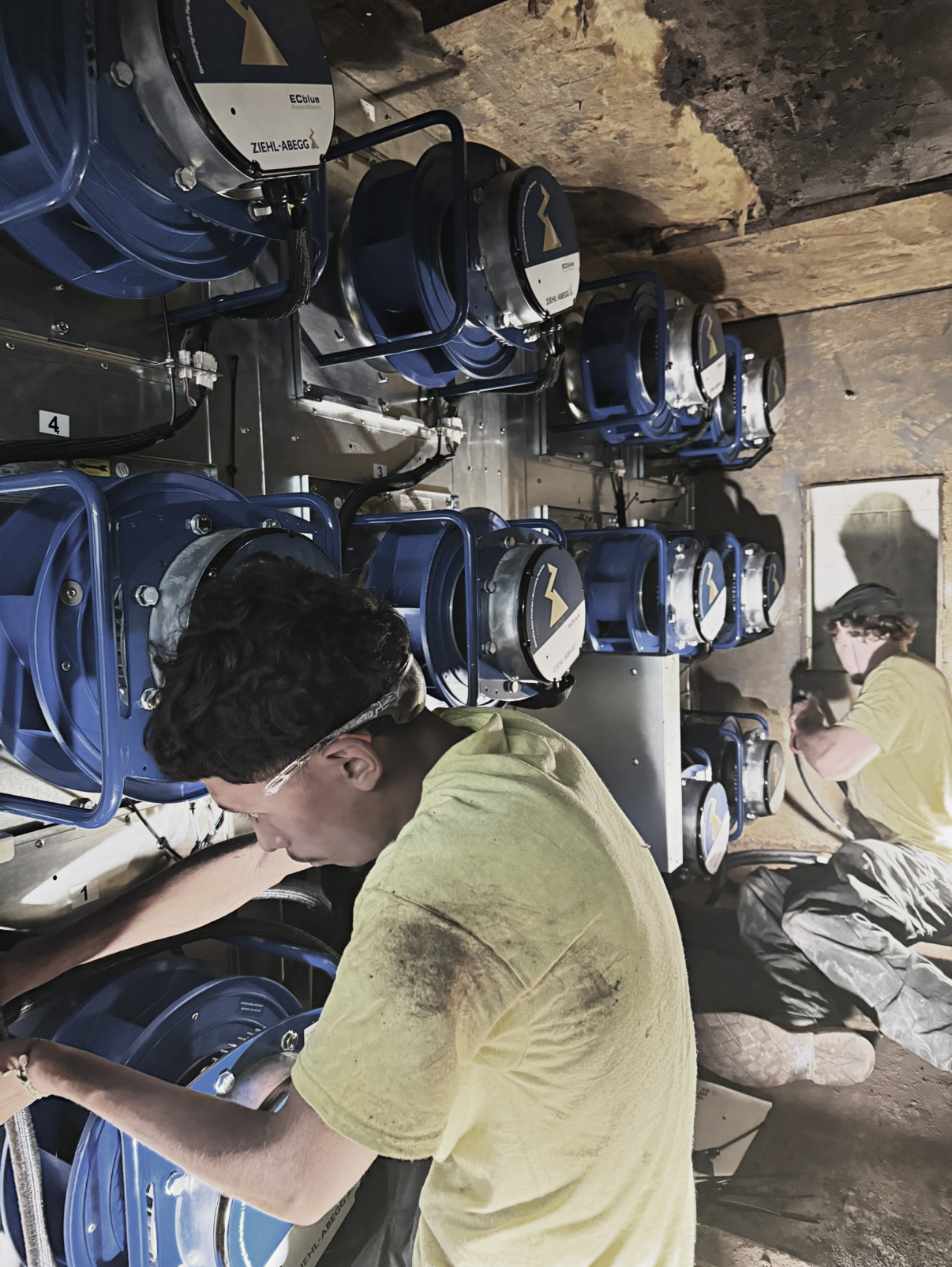
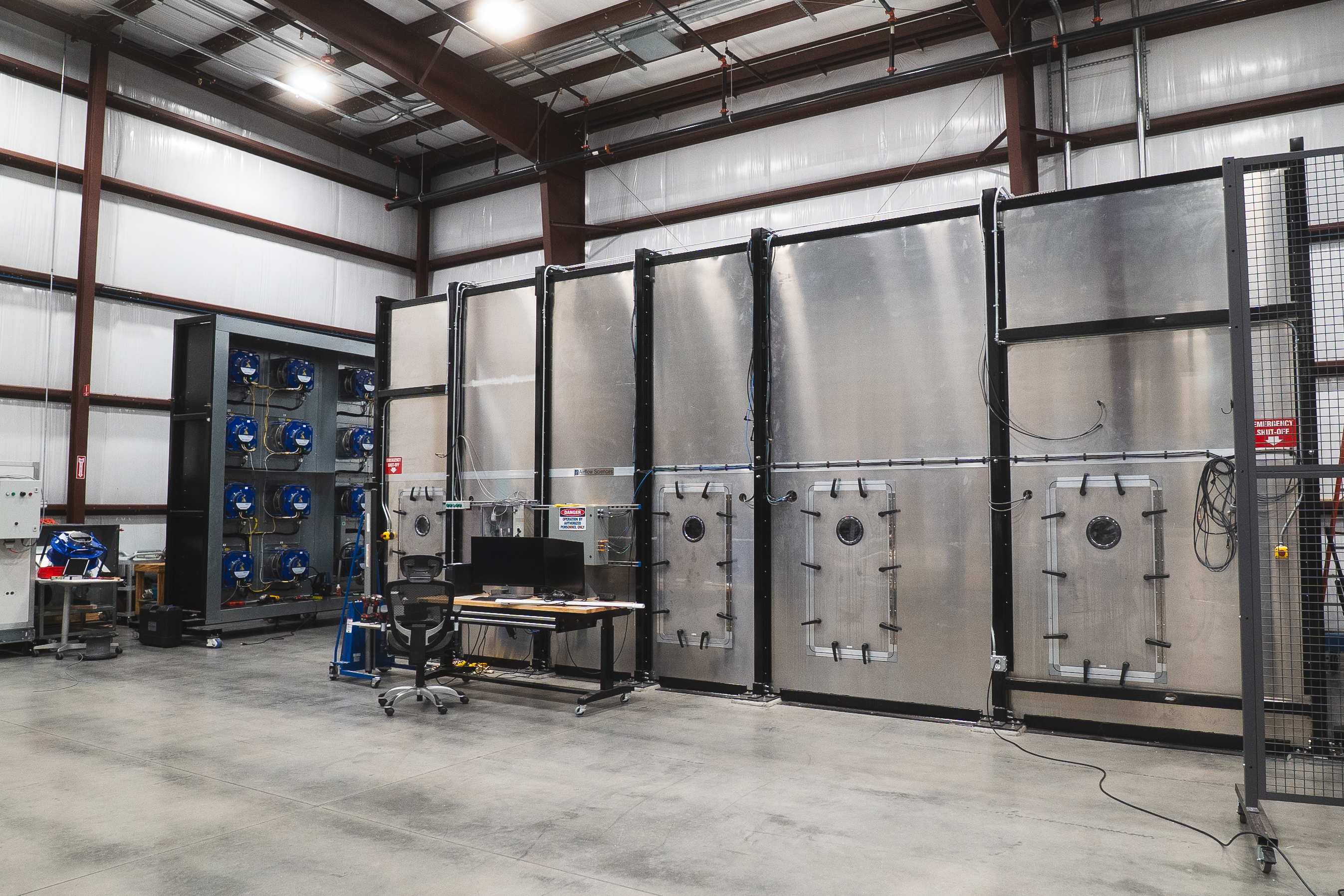
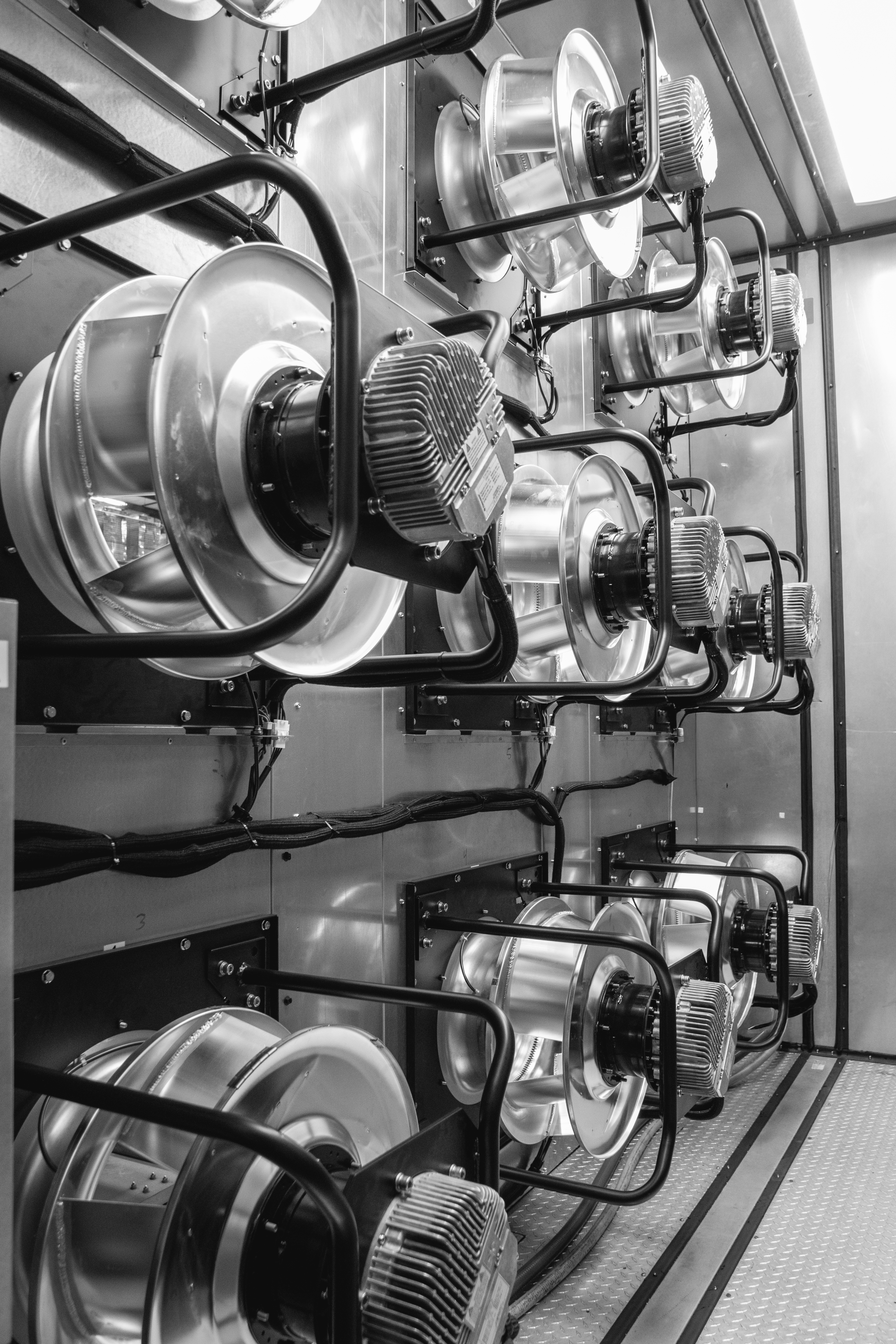
A fan array is a collection of smaller fans, often mounted to a bulkhead/pressure wall or stacked in a cube formation. Fan arrays are typically used in critical applications where airflow reliability is top priority. The arrays can be made up of multiple AC motors, direct drive plenum fans, EC (electronically commutated) motor fans, or even axial fans. Fan arrays can sometimes reduce the required footprint of the fan section in an air handler and may allow for field assembly, making it a good option for fan replacement applications. When a single fan fails, the other fans can continue to provide airflow, eliminating the emergency downtime. Fan arrays require advanced controls and commissioning, making them complex to install and control. Most fan arrays are uniquely designed, making them non-standard and demanding long-term support.
Pros
- Extremely variable air performance - With multiple smaller fans, operating efficiently at different duty points is achievable.
- Airflow redundancy - A failed fan does not entirely stop airflow.
- Flexible sizing - Fan arrays can fill the entire airstream, creating an even flow profile across a coil or airstream.
Cons
- Complex controls - Having to operate multiple fans can result in large control panels and bloated BMS interfaces.
- Maintenance difficulty - Fan arrays can be challenging to maintain, especially if fan replacement is not easy or if motor addressing is required.
- Unpredictable Vibration - Due to unique configurations and variable performance, vibration can be damaging (if not purposefully avoided).
Multimotor Plenum Fans
What are they?
Multimotor plenum fans (MPFs) are a new type of fan for commercial air handlers. They combine the airflow redundancy of fan arrays with the control simplicity of a single fan. MPFs have a custom frame, multiple motorized impellers, and a controller on the frame that serves as the single location for connecting power and controls. The motors can be direct-drive EC or AC. This single connection allows the operation of multiple motors to be as straightforward as a single one. The MPF is best suited for applications where airflow reliability and no maintenance schedule are preferred. The motorized impellers can easily be removed and replaced with no addressing or custom controls. An MPF allows for the upgrade of motors due to its adaptive motorized impeller mounting, resulting in longevity of support. The deprecation of a motor model does not require a new MPF.
Pros
- Extremely variable air performance - With multiple motors, operating efficiently at different duty points is achievable.
- Airflow reliability - A failed motor does not entirely stop airflow.
- Single-point power and controls - The single controller in the airstream enables control of the MPF like a single fan.
- Assembled or knock-down variants - Can be delivered in different ways depending on assembly location.
Cons
- Increased risk of vibration - Due to unique configurations and variable performance, vibration may be damaging (if not purposefully avoided).
- Motor HP limitations - MPFs utilize smaller, more maneuverable motors to prioritize ease of maintenance and installation. Due to the direct relationship between increased HP and size/weight, larger HP motors are unsuitable for this implementation.
- Increased up-front cost - The MPF may cost more than a traditional blower, but lifetime costs will be less expensive due to the lack of required scheduled maintenance, lack of specialized labor requirements for operation/servicing, and decreased power consumption.